


Minox 8x11 Submin Guide: Cutting film, loading cassettes, developing and scanning yourself
Community Tip: moments-of-now.com
Thomas Siepmann has been documenting his experiences with Minox cameras for years — detailed guides, film tests and practical tips. Absolute must-read for Minox beginners.
The Minox 8x11 format is one of the most fascinating chapters in photographic history: A spy camera that fits in the palm of your hand and delivers images that surprise. But getting started in subminiature photography can be confusing — which camera? Which film? How to develop? How to digitize?
Here you will find everything you need — from camera selection to the finished scan. Concrete recommendations, practical tips, sources of error.
Table of contents
- Camera selection — Which Minox for starters?
- Film selection — Buy ready-made or load your own?
- Cassettes & Tools — Loading film yourself
- What to look out for when shooting?
- Developing — Lab or at home?
- Digitizing — Methods compared
- Digitizing with the Ausgeknipst Setup
1. Camera selection — Which Minox for starters?

Photo: Central Intelligence Agency (CIA) — Public Domain via Wikimedia Commons
Minox cameras are tiny, precise and surprisingly powerful — but which model is right for you? The relevant models at a glance — with concrete purchase recommendations.
The Minox family at a glance
All 8x11 Minox cameras share the same basic principle: A sliding metal body, a fixed 15mm lens, guess focus and a film transport that works automatically when the camera is opened and closed.
| Model | Year of manufacture | Lens | Shutter | Light meter | Battery | Used price |
|---|---|---|---|---|---|---|
| Minox A / IIIs | 1948–1969 | 15mm f/3.5 Complan | 1/2–1/1000s + B | None | None | €140–280 |
| Minox B | 1958–1972 | 15mm f/3.5 Complan | 1/2–1/1000s + B | Selenium (external) | None | €180–370 |
| Minox BL | 1968–1972 | 15mm f/3.5 Complan | 1/2–1/1000s + B | CdS | PX27 (5.6V) | €230–420 |
| Minox C | 1969–1978 | 15mm f/2.8 Color-Minotar | 1/4–1/500s | CdS + Auto | PX27 (5.6V) | €280–460 |
| Minox EC | 1974–1978 | 15mm f/3.5 Color-Minotar | 1/30–1/500s (Auto only) | CdS | PX27 (5.6V) | €230–370 |
| Minox LX | 1978–1990s | 15mm f/3.5 MCA Rokkor | 1/2000–34s + B/T | CdS (TTL) | PX27 or adapter | €370–650 |
| Minox TLX | 1988–1990s | 15mm f/3.5 | Auto + Manual | CdS | Button cell | €320–550 |
| Minox CLX | 1980s–1990s | 15mm f/3.5 | Auto | CdS | Button cell | €280–460 |
Our recommendation: Minox B or Minox A
We recommend the Minox B for getting started — for one simple reason: it doesn't need a battery. The selenium light meter works purely mechanically and still delivers usable values after 60+ years (provided the selenium cell is still intact). In addition: The B is by far the most common model on the used market, spare parts and CLA services (Clean-Lube-Adjust) are available.
The Minox A (or IIIs) is the alternative for purists: Completely mechanical, no light meter, no battery, nothing that can break. Exposure is estimated using the Sunny 16 rule or measured using a smartphone app.
Budget tip: Minox EC — The cheapest option, fully automatic and idiot-proof. Disadvantage: No manual control and battery-dependent (PX27 required).
What to look out for when buying used
- Test sliding mechanism — The camera must open/close cleanly, without resistance or scratching
- Check focus wheel — Must rotate evenly, from 20cm to infinity
- Listen to the shutter — Click through all speeds, listen for a consistent sound
- Light meter (for B/BL/C) — Test in different lighting conditions, compare with smartphone app
- Film transport — Opening/closing should advance the film counter
- CLA service — A serviced camera is worth its weight in gold. Budget: ~€80–120 at a specialist
Purchase sources: eBay (classifieds + international), Photrio.com Forum, Minox clubs, local flea markets.
Non-Minox cameras for 8x11
- Yashica Atoron (1970s) — 15mm f/2.8, CdS meter, auto exposure. Cheaper than Minox (€90–180), solid entry-level, but not as high-quality workmanship.
- VEF Riga — The historical forefather of the Minox (Latvian production before the Second World War). Collector's item with fixed focus and no light meter. Attention: Our 3D-printed film cassettes do not fit the VEF Riga — the cassette dimensions are slightly different.
2. Film selection — Buy ready-made or load yourself?

Photo: Wikimedia Commons — Minox Film Slitter
Original Minox film is no longer produced — but that's not a problem. Today you have two ways to get film: Buy ready-made or load it yourself. And the DIY route is not only cheaper, but gives you free choice from the entire 35mm film range.
Option 1: Buy ready-made Minox film
There are still a few sources for pre-loaded 8x11 film:
- Blue Moon Camera (USA) — Specialist for subminiature film, ~$26/roll
- Fotoimpex (Germany) — Occasionally Minox film in stock
- NOS (New Old Stock) — Original Minopan, Minocolor or Minox SPY film on eBay. Caution: Expiry dates often exceeded by 20+ years
Ready-made film is ideal for getting started — you get to know the camera without having to worry about the loading process at the same time. But it gets expensive in the long run.
Option 2: Load the film yourself — The practical alternative
The calculation is simple: From one 35mm film cartridge (€5–15) you cut 4 strips Minox film. Two of them can be used (9.2mm wide). This results in approx. 2 Minox films for the price of half a 35mm roll — so ~€3 per Minox film instead of €26.
You need this:
- A film cutter — e.g. our Ausgeknipst Filmschneider or the Camerhack Slitter
- A refillable cassette — e.g. our Ausgeknipst Filmkassette
Details on the cutting and loading process can be found in Chapter 3.
Which film works in 8x11 format?
Basically works any 35mm or 120 film — it just needs to be cut to 9.2mm width. Here are our recommendations depending on the intended use:
Black and white
| Film | ISO | Strength | Ideal for |
|---|---|---|---|
| Ilford FP4+ | 125 | Fine grain, high resolution | Landscape, architecture |
| Ilford HP5+ | 400 | Versatile, easily pushable | Street, travel, all-rounder |
| Kodak Tri-X 400 | 400 | Legendary grain, high contrast | Street, documentation |
| ADOX CMS 20 II | 20 | Most extreme resolution (400 lp/mm) | Maximum sharpness |
| Fomapan 100 | 100 | Budget option, good grain | Getting started, experimenting |
Colour (C-41)
| Film | ISO | Strength | Ideal for |
|---|---|---|---|
| Kodak Ektar 100 | 100 | Finest grain, high resolution | Landscape, best colour quality |
| Kodak Gold 200 | 200 | Warm, inexpensive | Everyday life, travel |
| Kodak Portra 400 | 400 | Natural skin tones | Portraits, people |
| CineStill 50D | 50 | Cinematic colour profile | Daylight, characterful images |
ISO choice: What the small format dictates
With the 8x11 format, the resolution of the negative is the limiting factor — not the camera. The tiny negative (8×11mm = 88 mm²) has to be enlarged significantly, and every film grain structure becomes a problem.
Rule of thumb: ISO 50–100 delivers the best results. ISO 400 is the practical compromise. Above that, the grain becomes dominant and eats away at details.
Megapixel equivalent
| Film | Resolution (lp/mm) | Theoretical MP equivalent |
|---|---|---|
| Kodak Gold 200 | 50 | ~1.5 MP |
| Kodak Ektar 100 | 100 | ~5 MP |
| Ilford FP4+ | 120 | ~7 MP |
| ADOX CMS 20 II | 400 (lens-limited) | ~15–20 MP |
In practice: 3–8 MP effective resolution — depending on film, focus and shake. Enough for social media, websites and smaller prints (up to approx. A5).
Warning: High-Speed Films and Light Leaks
Films with ISO 800 and higher (especially Ilford Delta 3200) are extremely sensitive to light — and the small cassette format offers less light protection than a 35mm cartridge. Our recommendation: Stay at ISO 400 and push in development.
3. Cassettes & Tools — Loading Film Yourself

Loading film yourself sounds more complicated than it is. With the right tools, the process takes less than 10 minutes — and you save ~85% compared to ready-made Minox film.
What you need
- A Film Slitter — to cut 35mm film to 9.2mm width
- A Refillable Cassette — that holds the film and fits into the camera
- Tape — to attach the film leader to the take-up spool
- A Storage Case — for the loaded cassette
The Film Slitter
Ausgeknipst Film Slitter (SKU 1591p)
- Cuts 35mm, 120 or 16mm film to exactly 9.2mm Minox width
- Modular design: interchangeable inserts for different source formats
- Daylight operation — the film is protected in the slitter
- Safety cover prevents accidental opening
Camerhack Daylight Slitter (~$35) — Simpler design, works well. One 35mm cartridge yields 4 strips, 2 of which are the correct width.
The Film Cassette
Ausgeknipst Film Cassette (Refill) 8x11 (SKU 1522b)
- 3D-printed replacement cassette for 36 exposures
- 4-part design: Feeding Chamber, Film Chamber, Take-Up Spool, Lid
- Compatible with: Minox A, B, BL, C, EC, LX, TLX, CLX, MX, Sharan, Yashica Atoron
- LX cameras: Automatic counter reset when inserted
Important: Important: ONLY use 36 exposure cassettes! The 15 exposure cassettes have a different spool diameter and do not fit in all camera models.
Loading Film — Step by Step
Preparation (in daylight):
- Cut film — Insert 35mm film into the slitter and cut to 9.2mm
- Prepare tape — Cut a piece (9mm high × approx. 45mm long)
- Have cassette ready — Only open the Feeding Chamber
Loading (in COMPLETE darkness!):
- Attach film leader — Fix the film strip to the take-up spool with the tape
- Wind film — Wind carefully and evenly, emulsion inwards
- Close cassette — Attach the Feeding Chamber and let it click into place
- Immediately into the case — Put the loaded cassette directly into the storage case
Tips from the field (Source: moments-of-now.com):
- A changing bag (Dark Bag) is cheaper than a whole darkroom
- Practice with an old film the first time — in the light, to understand the mechanism
- The take-up spool should rotate freely — if it jams, re-roll the film again
Video Tutorial: Loading Film Step by Step
Andrew Long shows the complete loading process in his detailed tutorial — from preparation to the finished cassette:
Practical Test: Community Feedback
Independent test by Thomas Siepmann (moments-of-now.com)
Thomas tested our cassette in a Minox A with ISO 200 film and had it developed in a professional lab:
- Light tightness: Sufficiently light-tight when handled correctly. Even with intentional exposure to extreme midday sun (EV 15), there is only minimal light ingress at the end of the film — no problem with normal cassette changes in the shade.
- Film transport: Even spacing between negatives, no increased resistance.
- Scratches: No scratches visible on the developed film.

Test strip from a Minox A — correct frame spacing, no scratches. Slight light leak at the end of the film only with intentional extreme exposure (EV 15). Photo: Thomas Siepmann / moments-of-now.com
4. What to watch out for when shooting?

Photo: Wikimedia Commons — Minox EC & LX
8x11 photography has its own rules. The negative is tiny — every mistake in exposure, focus or camera shake is mercilessly magnified. A few things that make the difference.
Set the exposure correctly
Cameras with light meter (B, BL, C, EC, LX): The built-in meters are surprisingly useful on most models. If you are unsure: Compare with a smartphone app (e.g. LightMeter or PhotoMate).
Cameras without light meter (Minox A): The Sunny 16 rule is your best friend — sun: f/16, 1/ISO value. Cloudy: f/8. Shadows: f/5.6.
Focusing — Mastering estimate focus
All Minox cameras work with estimate focus. The trick: Use hyperfocal distance. At f/3.5 and 15mm focal length, the depth of field is surprisingly large. Focus on ~2 meters — everything from ~1m to infinity will be sharp. For street photography, just set it to 2 meters and forget it.
Camera shake — The biggest problem in 8x11
Camera shake is in the 8x11 format significantly more critical than with 35mm because the negative has to be enlarged more.
- At least 1/125s for sharp handheld shots
- Hold the camera steady — support arms or lean against a wall
- Gently press the shutter — don't jerk
Image composition for 8x11
- Simple motifs work best — a clear subject, little distraction
- High contrast helps — hard-contrast scenes look better than flat ones
- Get close — Minox pictures benefit from proximity, not from wide-angle panoramas
Practical checklist
- Bring a spare cassette (loaded + in the can)
- Only change cassettes in subdued light
- Check the camera before shooting: Has the film counter advanced?
- In the cold: Warm up the camera slowly (condensation possible)
5. Developing — Lab or at home?
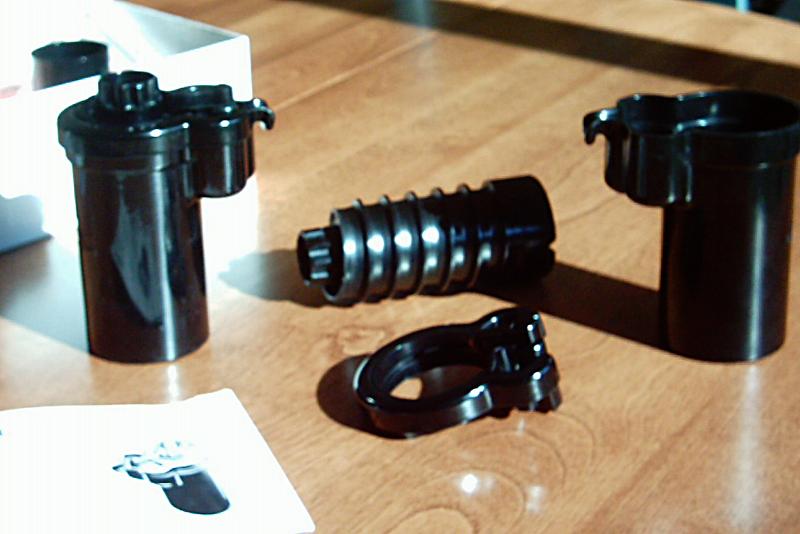
Photo: Wikimedia Commons — Minox Daylight Development Tank
Your Minox film is exposed — now it needs to be developed. This is the step where many beginners become unsure because 8x11 doesn't fit into the standard workflow of most photo labs. There are three ways.
Option 1: Have it developed in the photo lab
The biggest problem: Most labs cannot process 8x11. But there is a clever trick:
The C-41 trick: Pour Minox film into a 35mm cartridge
In the dark, remove the Minox film from the cassette and spool it into an empty 35mm film cartridge. Give to a normal lab — the machine develops the film as normal. Mark well: "Do not cut film!" Cost: ~€5 per film, approx. 1 hour turnaround. Only works for C-41 (color negative).
Special labs for 8x11:
- Fotoimpex (Germany) — Specialist for analog photography
- Blue Moon Camera (Portland, USA) — Specialist for Subminiature
- ag photographic (UK) — Subminiature development and scan
Option 2: Develop at home

Developing yourself gives you full control over the process — and is significantly cheaper than the lab in the long run. The standard reels from Jobo and Paterson are made for 35mm 8x11 does not fit. That's why we developed dedicated reels:
| Product | SKU | Tank compatibility | Price |
|---|---|---|---|
| Ausgeknipst 8x11 Reel for Jobo | 1505p | All Jobo 1500 and 2500 | €24,95 |
| Ausgeknipst 8x11 Reel for Paterson | 1502b | All Paterson Super System 4 | €29,95 |
SW development: The process
- Spool in film (in the dark/changing bag) — load film strip into the 8x11 spool
- Developer — e.g. Rodinal 1+50, 10–12 min. at 20°C
- Stop bath — 30 seconds
- Fixer — 5 minutes
- Washing — 10–15 minutes running water
- Wetting agent — Drop of Agepon or dish soap against water spots
- Drying — Hang up film, dust-free environment
C-41 Color Development at Home
With a C-41 Kit (e.g. CineStill Cs41, Tetenal Colortec) color development is also feasible. Temperature critical: 38°C ± 0.5°C. One kit is enough for ~16–24 films.
6. Digitizing — Methods Compared

Photo: Wikimedia Commons — Original Minox Copystand
You have developed the film — now you have to turn the tiny negatives into digital images. Not every method that works for 35mm is suitable for 8x11. The format places special demands on resolution.
Why 8x11 Places Special Demands
The Minox negative is 88 mm² in size — about 1/10 the area of a 35mm negative. To get a Minox negative to A4, you need a magnification of ~27×. With 35mm it is only ~8×. Every pixel counts.
The Methods at a Glance
| Method | Effective Resolution | Cost | Speed | Recommendation |
|---|---|---|---|---|
| Flatbed Scanner (e.g. Epson V600) | ~3200 dpi | €250 | Slow | No Not Sufficient |
| Plustek 8200i | ~5000–7200 dpi | €400 | Slow | Caution: Possible, Holder needed |
| Compact Camera + Loupe | ~10000 ppi | €110 | Medium | Budget Surprise |
| DSLR/Mirrorless + Macro | ~6000–12000 ppi | €150–300 | Fast | Best Quality |
| Smartphone + Macro Lens | ~5000 ppi | €10–30 | Fast | For starters |
Flatbed Scanner — Why It's Not Enough
Most flatbed scanners have an optical resolution of ~3200 dpi. For an 8×11mm negative, this only results in an image of approx. 1000×1400 pixels — less than 1.5 megapixels. Not recommended.
DSLR/Mirrorless + Copy Stand — The Best Method
Camera Scanning is clearly the superior method for 8x11:
- Resolution: A 24MP APS-C sensor with 1:1 Macro delivers ~12000 ppi on the negative
- Speed: 10 seconds per frame
- Color fidelity: Raw light + RAW data = maximum control
- Flexibility: The same equipment scans 35mm, 120 and 4x5
Software for Post-Processing
- Negative Lab Pro — Lightroom plugin, premium standard (~$99)
- darktable negadoctor — Open Source, free
- FilmLab — Standalone app, also for smartphones
- Topaz DeNoise AI — AI noise reduction for high-ISO scans
7. Digitizing with the Ausgeknipst Setup

If you want to get the most out of your Minox negatives, you need a well thought-out camera scanning setup. We show you our modular system — from the base plate to the finished image.
The Complete System at a Glance


Purple = Minox-specific · Gray = Shared (all formats)
Copy Stand MK2

Ausgeknipst Copy Stand MK2 (SKU 1602b) — 60cm aluminum profile on 20mm screen printing plate, CNC-milled profile mount, 3/8" tripod thread, 2× Fast-Lock clamps. Tool-free assembly and disassembly in seconds.
CineStill CS-LITE + CSL Adapter
CineStill CS-LITE (SKU 1725v) — SpectraColor full-spectrum LED with CRI 97+. The CSL Adapter Mini (SKU 1664p) connects the CS-LITE light-tight to the Scanner — no stray light.
Film Scanner Set Minox 8x11
Film Scanner Set Minox 8x11 (SKU 1651b) — Dedicated 9.2mm film channel, dual S-curve for perfect flatness, 4 neodymium magnets, matte black (PLA+).
Hood S + Extension Tubes
Lens Hood Mini (Hood S) (SKU 1661p) — Stray light protection. Extension Tubes (40mm + 60mm) — Correct working distance for macro lenses.
Camera and lens recommendations
| Sensor | Example cameras | Effective resolution |
|---|---|---|
| APS-C 24MP | Sony a6000/a6400, Fuji X-T3 | ~10000+ ppi |
| Full frame 24MP | Sony a7 III, Nikon Z5 | ~8000+ ppi |
| Full frame 42–61MP | Sony a7R IV, Nikon Z7 | ~14000+ ppi |
Conclusion: APS-C with 20+ MP is perfectly sufficient. Full frame is a bonus, but not a must.
Macro lenses: Venus Laowa 65mm f/2.8 2× Ultra Macro (APS-C), Sony 90mm f/2.8 Macro, Nikkor Z MC 50mm f/2.8, Canon RF 100mm f/2.8 L Macro.
The workflow: From negative to finished image
- Set up — Copy Stand → CS-LITE → Adapter → Scanner → Hood
- Mount camera — Align vertically on the 3/8" mount
- Live View + Focus Peaking — Focus on the film grain
- Insert frame — Push film into the scanner, attach Top Plate
- Capture + advance — Photograph frame (2s timer), move film, position next section
- Post-Processing — Import → Negative Conversion → Crop → Denoise → Export
Sets and prices
| Set | Content | Price |
|---|---|---|
| Basic | Film Scanner Minox 8x11 + Top Plate | €59,95 |
| Pro | Basic + Hood S + CSL Adapter Mini + CineStill CS-LITE | €139,95 |
| Full | Pro + Copy Stand MK2 + Extension Tubes | €289,95 |
Recommendation: If you already have a copy stand or light source, the Basic Setis sufficient. For a new setup, the Full Set is the best way to start — everything fits together perfectly and you save money compared to buying individually.
Unsure which scanner set you need?
3 questions, personalized recommendation – in under 60 seconds.
Interactive range diagram
All components in a layered structure — clickable with direct shop links.
All blog articles at a glance
Guides, tips and technical background information about analog photography and film scanning.
Minox 8x11 overview
Find all suitable products, films and adapters in our overview.
To the Minox 8x11 system